


PRODUCT DATA SHEET (PLM & PDM) AND COSTS
Unified fashion PLM & PDM: styles and items built as a matrix, one bill of materials for all colours and sizes, internal and external operations, standard cost and actual average cost, geopricing price lists and a multilingual product data sheet in PDF. Product lifecycle and technical data are created here and serve the whole company.
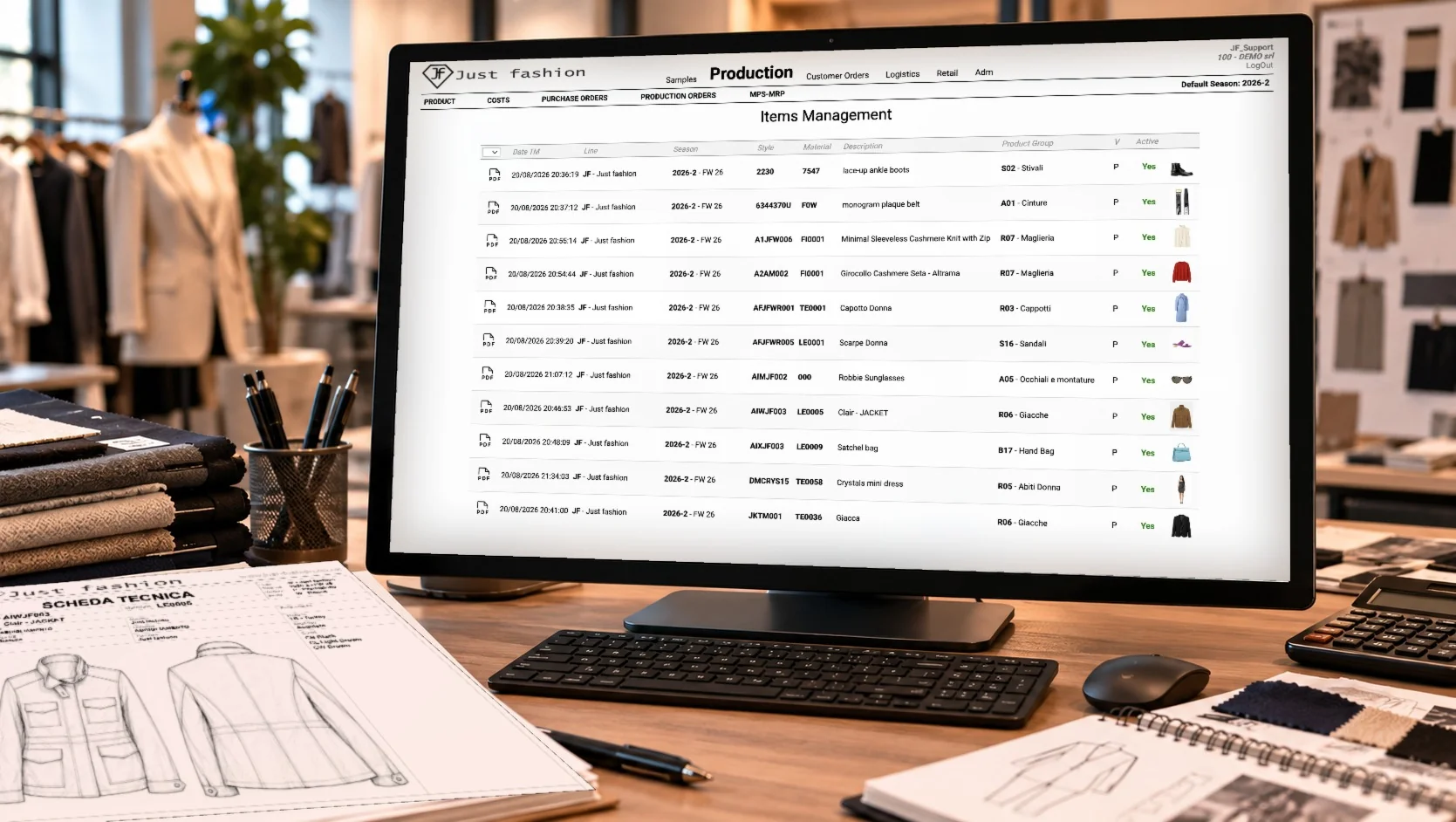
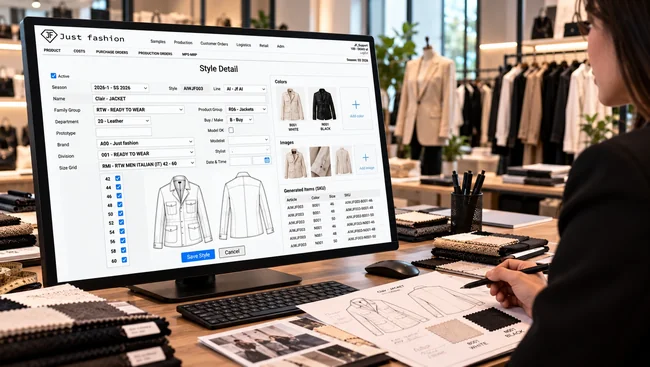 1Styles and items as a matrix↓
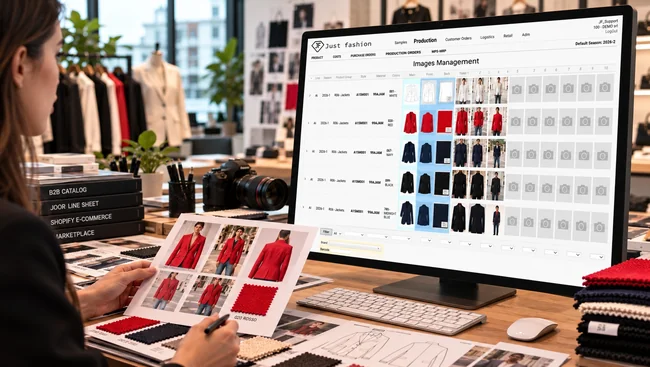 2Images, from sketch to channels↓
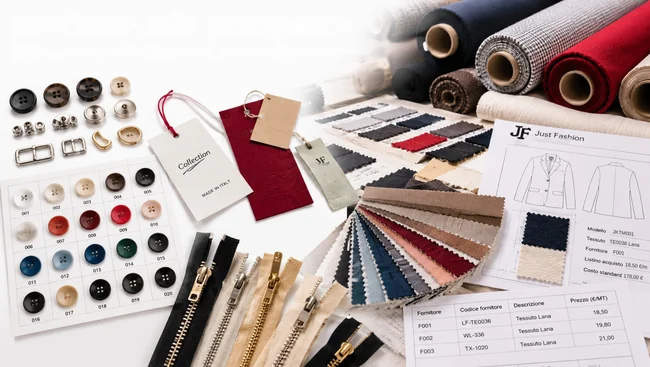 3Materials, suppliers and price lists↓
 4Matrix bill of materials↓
 5Internal and external operations↓
 6Standard cost and average cost↓
 7Geopricing sales price lists↓
 8Size grading↓
 9Compositions and care labels↓
 10Product data sheet and versions↓
Everything the company knows about a garment, in one sheet.
In fashion the same product is described many times: by design, pattern making, purchasing, production, sales and logistics. If everyone describes it their own way, in a different file, the mistakes reach the customer: a wrong cost, a composition that does not match the label, a customs code missing from the invoice.
In Just Fashion the product data sheet (PLM & PDM) is where the product takes shape, once: style, colours and sizes, bill of materials with materials and operations, standard cost, sales price lists, compositions, labels and customs data. Customer orders, production planning, shipping documents and digital channels all start from here.
Season and sales line, everywhere
Just Fashion is a vertical ERP for fashion, and in fashion everything is organised by season and by line. That is why the season and the sales line are not filters added later: they are present in all master data and across the whole system. Items and materials, bills of materials, purchase and sales price lists, costs, orders, production, warehouse and analytics are always linked to their season and their line.
Every user works on a default season, always shown at the top of every screen, and can switch to another season when needed. Sales lines keep different brands and collections apart in the same system.
Bought or made: the standard cost always comes from the right data.
The standard cost is calculated by item. Just Fashion takes it from two different sources, depending on how the product is made.
From the purchase price list
For products bought finished, the standard cost comes from the purchase price list of the supplier linked to the item.
From the bill of materials
For products you make, the standard cost is built from the bill of materials: the materials, valued at their purchase prices, and the internal and external operations.
Alongside the standard cost, Just Fashion calculates the actual average cost from real warehouse receipts. See module 6.
The same master data, from prototype to production garment.
In Samples Management the item is created with the essential data and a bill of materials for the sample colours and size only, with no costs. When the garment enters the collection, the same master data is completed here.
All colours and all sizes are added, together with the materials and operations of the production bill of materials, compositions, made in and customs data, the standard cost and the sales price lists. The versions of the product data sheet (prototype, sample, production and as many as you need) remain available.
What is added for production
- ✓All the colours of the collection, with bulk colourway assignment in the bill of materials
- ✓All sizes, with quantities and measures by size
- ✓Internal and external operations, linked to workshops and subcontractors
- ✓Standard cost of the item
- ✓Sales price lists by line, market and currency
- ✓Compositions, labels, made in and HS codes
From style to production, with nothing re-keyed.
Each step uses the data of the step before. Cost and material requirements are calculated from the same bill of materials.
Ten modules, one product record
Organised in three areas: product, bill of materials and costs, technical data.
1. Styles and items as a matrix
The sketch and technical drawing of a style get a unique code, a description, a size range and a family group that follow it for its whole life. Line, season and colour card complete the classification.
Items are created as a matrix: from the combination of style, size range, materials, colours, measures and variants, all the sellable variants are generated automatically, with their SKU codes, ready for price lists, catalogues and orders.
The same master data works for every category: apparel, knitwear, footwear, bags, belts, gloves, eyewear, beachwear. Every item has its own image and its own PDF sheet, one click from the list.
- Unique style code, size range and family group
- Lines, seasons and colour cards
- Matrix of size range, materials, colours, measures and variants
- Automatic generation of items and SKUs
- Technical drawing and images linked to the style
2. Images, from sketch to sales channels
Product images live in the same master data, from the first day to the last. It starts with the sketch and the front and back technical drawing of the style, which go with the product data sheet and the documents for the workshops.
Then come the photos, organised by style and by colour: main image, front, back, fabric swatch and sales photos. Each colour has its own images, so every variant is shown with the right photo.
The same images serve every channel: B2B, with catalogues for agents and showrooms and JOOR linesheets, and B2C, with e-commerce on Shopify and marketplaces.
And when the photos are not ready yet, JF AI, the artificial intelligence of Just Fashion, steps in: starting from the sketch of the style and matching it with the swatch, the fabric sample, it generates a realistic photo of the garment in that fabric and that colour. You get images of every variant already during the sampling stage, before the photo shoot, ready for catalogues and sales channels.
- Sketch and technical drawing of the style
- Photos by style and by colour
- Main image, front, back, swatch and sales photos
- Images in B2B catalogues and JOOR linesheets
- Images on B2C channels: Shopify and marketplaces
- With JF AI, a realistic photo of the garment from the sketch and the fabric swatch
- Images of every colour before the photo shoot
3. Materials, suppliers and purchase price lists
Fabrics, linings, interlinings, leathers, trims and packaging have their own master data. Each material is managed by colour, by measure, by colour and measure or as neutral, depending on how it is bought and used.
Each material and each bought product is linked to one or more suppliers, with their codes and their purchase price lists. These are the prices the standard cost comes from: for materials, and therefore for manufactured garments, and for products bought finished.
- Cut materials and trims
- Managed by colour, by measure, by colour and measure, or neutral
- Several suppliers per material, with supplier codes and references
- Purchase price lists for materials and finished products
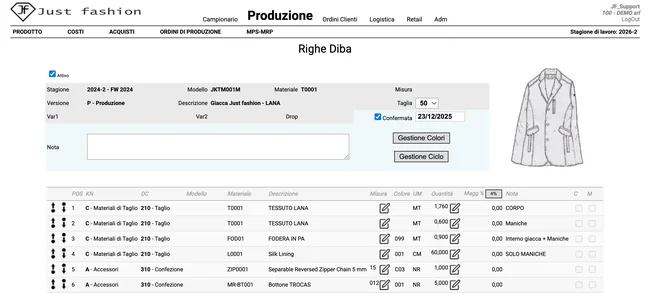
4. Matrix and multilevel bill of materials
The bill of materials contains materials and operations and can be multilevel: a component can have its own bill of materials.
Above all, it is a matrix. Components are entered as neutral, then bulk colourway assignment gives each colour of the item the right colour of fabrics, linings and trims. Where needed, quantities by size or measures by size are set: button ligne, zip length, size label, shoe upper. So an item with 5 colours and 6 sizes has one bill of materials, not thirty.
The bill of materials gives the standard cost of manufactured garments and the material requirements for production planning (MRP).
- Materials and operations in the same bill of materials
- Multilevel bill of materials
- Neutral components and bulk colourway assignment
- Quantities by size and measures by size
- One bill of materials per item, for all colours and sizes
- Basis for standard cost and MRP
| Component | How it is entered | In the bill of materials |
|---|---|---|
| Wool fabric body and sleeves | Neutral + colourway | B001 white on the white jacket, N001 black on the black jacket |
| PA lining jacket interior | Neutral + colourway | The same colour, 099 black, for both colours |
| Silk lining sleeves only | Neutral + colourway | In contrast: black on the white jacket, white on the black one |
| Buttons | Measure and quantity by size | Ligne 012 up to size 52 and 014 from 54; 5 buttons, 6 from 54 |
| Zip | Measure by size | Measure 15, measure 16 in sizes 54 and 56 |
| Operations | Cycles | Cutting, sewing, pressing and packaging |
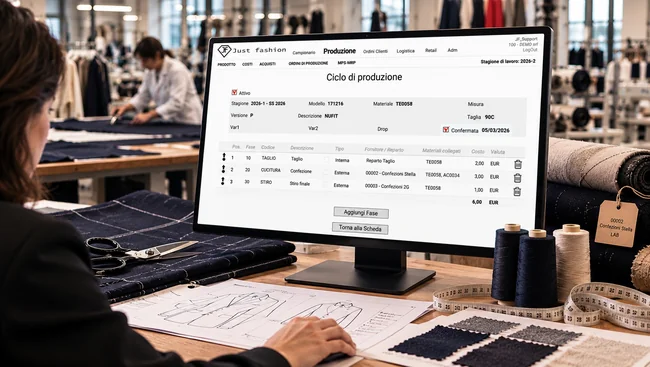
5. Internal and external operations
Operations are part of the bill of materials. They can be internal phases, carried out in the company's own departments, or external phases, given to workshops and subcontractors.
Each operation is linked to the materials it works on and to the workshop that carries it out. So the bill of materials tells you not only what the garment is made of, but also where and by whom it is made, and what it costs to make.
- Internal and external phases
- Operations linked to materials
- Operations linked to workshops and subcontractors
- Cost of operations in the standard cost
6. Standard cost and actual average cost
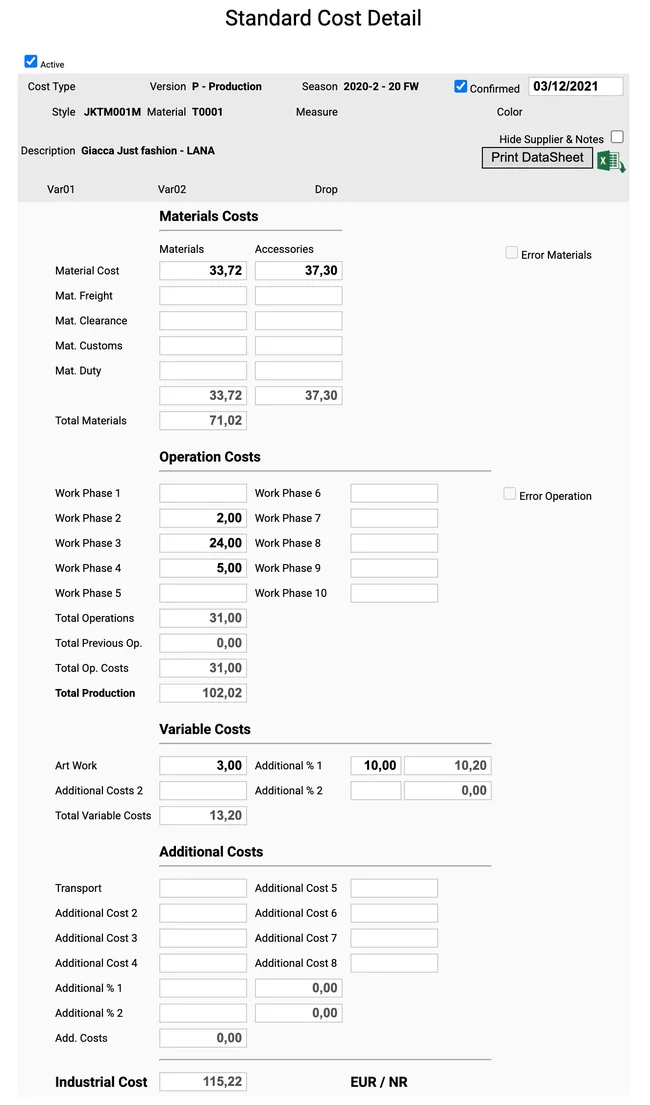
The standard cost is calculated by item: from the purchase price list for bought products, from the bill of materials (materials and operations) for manufactured products. It is the reference cost of the collection.
The cost detail shows every component: materials and trims, the cost of each operation phase, then variable costs (pattern making, fixed costs, percentage costs) and additional costs such as transport, up to the industrial cost of the item.
The actual average cost, instead, comes from real warehouse receipts: it is the weighted average of the received lots of materials and finished goods, valued at purchase price, that is the total value of the receipts divided by the quantity. It can also be configured by colour and by variant.
The two costs work together: the standard cost to build the collection and the prices, the actual cost to know what the goods received into the warehouse really cost. Both feed order margins.
- Standard cost by item
- Materials, trims, operations, variable and additional costs up to the industrial cost
- From the purchase price list for bought products
- From the bill of materials for manufactured products
- Actual average cost as a weighted average of receipts
- Average cost configurable by colour and variant
Example: actual average cost of a fabric
| Received lot | Metres | Price €/m | Value € |
|---|---|---|---|
| Lot 1 | 100 | 10.00 | 1,000.00 |
| Lot 2 | 200 | 11.50 | 2,300.00 |
| Total | 300 | 3,300.00 |
€3,300.00 ÷ 300 m = €11.00/m actual average cost.
Example for illustration only.Standard and actual, to make decisions
The standard cost tells you what an item should cost according to its bill of materials or its price list. The actual average cost tells you what the goods really received did cost. Having both in the same system lets you build price lists on a solid cost and read the real margin of the collection.
7. Geopricing sales price lists
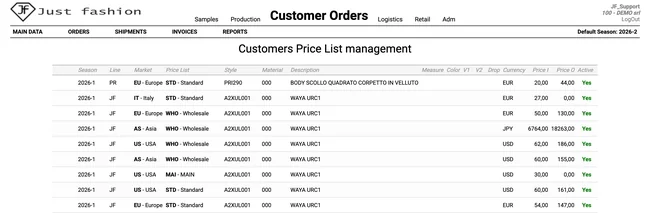
Sales price lists are calculated by line, market, price list code and currency: this is geopricing. The same item can have different wholesale and retail prices in Italy, Europe, the United States or Asia, each in its own currency.
They are the same price lists used by customer and agent orders, stores and digital channels such as Shopify and JOOR.
- Price lists by line, market, price list code and currency
- Wholesale and retail prices
- Several currencies at the same time
- The same price lists on orders, stores and digital channels
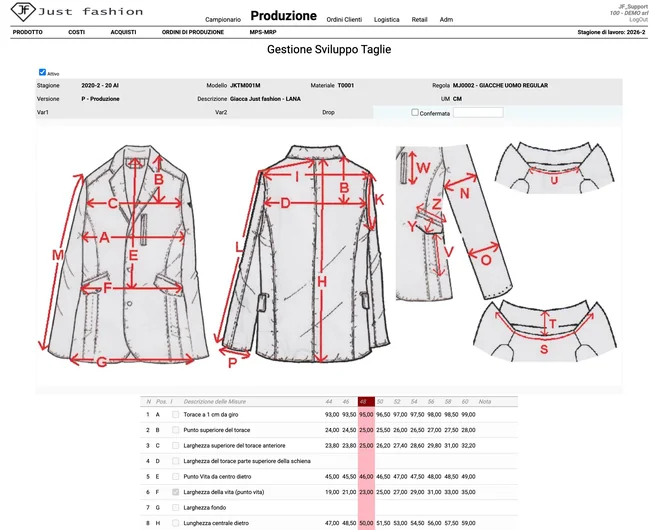
8. Size grading
Size grading describes how the garment changes from one size to the next, measuring point by measuring point. Measures start from the base size and follow a grading rule (for example men's regular jackets), with the technical drawing showing where each measure is taken.
The measurement table goes into the product data sheet and reaches the workshops together with the bill of materials and the manufacturing notes.
- Measuring points on the technical drawing
- Base size and grading rule
- Measures for every size in the size range
- Measurement table in the product data sheet, in PDF and Excel
9. Compositions and care labels
The composition is managed for every garment and every part of it: shell fabric, lining, padding, inserts, with the percentage of each fibre. It is entered once and is multilingual: the same composition is printed in the language of each market, for example "90% lana 10% elastan" becomes "90% wool 10% elastane".
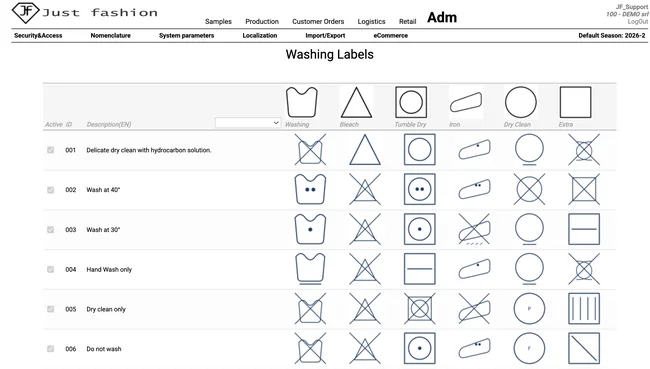
Care labels are managed in a table of codes. For each code, for example 003 Wash at 30°, you pick one symbol for each category: washing, bleach, tumble dry, iron, dry clean and an extra symbol. The description is translated into every language, and the symbol library itself can be edited. The code is assigned to the item and reused on every garment with the same instructions.
The composition travels with the other data needed for labels and customs: made in, weight, CITES data for leathers and protected materials and the HS customs code, generated with AI from the product data. It all ends up on the product data sheet, garment labels, catalogues and digital channels, invoices and export documents, without being re-keyed.
- Composition by garment part, with fibre percentages
- Multilingual compositions for every market
- Table of coded, reusable care labels
- Symbols for washing, bleach, tumble dry, iron, dry clean and extra
- International care symbols with multilingual descriptions
- Made in, weight and CITES data
- HS codes generated with AI
- The same data on product data sheet, labels, catalogues, e-commerce and customs documents
10. Multilingual product data sheet and versions
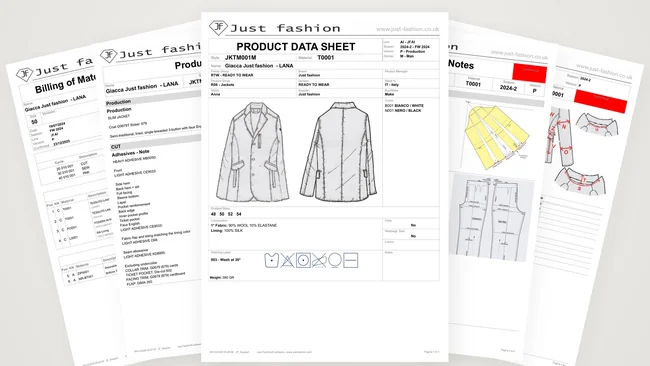
The product data sheet (PLM & PDM) brings everything together: style and technical drawing, bill of materials, operations, measures by size, compositions and technical notes with text and images for workshops and garment makers. It is exported natively as a PDF and is multilingual, to work with workshops and subcontractors in Italy and abroad.
True to comprehensive product lifecycle management (PLM), the product data sheet has versions: prototype, sample, production, and as many as you need, because you can code as many versions as you like. Each stage of the product lifecycle has its own sheet, and the previous one is never lost.
- Complete product data sheet in PDF
- Multilingual
- Technical notes with text and images
- Prototype, sample and production versions
- Unlimited versions, coded by the company
Main features
The functions of the product data sheet and costing, by area.
- ✓Unique style code, size range and family group
- ✓Lines, seasons and colour cards
- ✓Items as a matrix of colours, measures, sizes and variants
- ✓Sketch and technical drawing of the style
- ✓Photos by style and colour, with swatches, for B2B and B2C channels
- ✓Realistic garment photo generated with JF AI from the sketch and the fabric swatch
- ✓Materials by colour, by measure or neutral
- ✓Several suppliers per material, with purchase price lists
- ✓Multilevel bill of materials with materials and operations
- ✓Neutral components and bulk colourway assignment
- ✓Quantities and measures by size
- ✓One bill of materials for all colours and sizes of the item
- ✓Internal and external operations, linked to materials and subcontractors
- ✓Standard cost by item, from price list or bill of materials
- ✓Actual average cost, configurable by colour and variant
- ✓Sales price lists by line, market, price list code and currency
- ✓Material requirements for MRP
- ✓Size grading of measures
- ✓Compositions by garment part, multilingual
- ✓Coded care labels with international symbols
- ✓Made in, weight and CITES data
- ✓HS codes generated with AI
- ✓Technical notes with text and images
- ✓Multilingual product data sheet in PDF
- ✓Unlimited versions: prototype, sample, production
One record, every department.
The product data sheet is not a separate archive: it is the master data used by every other Just Fashion module. When a cost, a composition or a price list changes, it changes everywhere.
Related modules
- ✓Samples Management, where the item is born
- ✓Production and Supply Chain, MRP and production orders from the bill of materials
- ✓Customer Orders and Agents, price lists and margins
- ✓Shipping, Invoicing and Returns, compositions, made in and HS codes on documents
- ✓Shopify and JOOR, attributes and price lists on digital channels
- ✓JF AI, images and copy generated from the master data
One bill of materials for every colour. A cost you can trust.
We show you how an item is created as a matrix, how a single bill of materials covers all colours and sizes, and how the standard cost and the geopricing price lists are built.