


JUST FASHION ERP
The end-to-end ERP platform designed natively for apparel, fashion and luxury brands: from design and collection development to supply chain, omnichannel sales, warehouse logistics, retail POS and financial operations.

 1Styles & Materials↓
 2Bill of Materials↓
 3Compositions & Labels↓
 4Size Development↓
 5Technical Sheets & PDM↓
 6Orders, Agents & Showroom↓
 7POS Retail & Stores↓
 8E-commerce & Marketplace↓
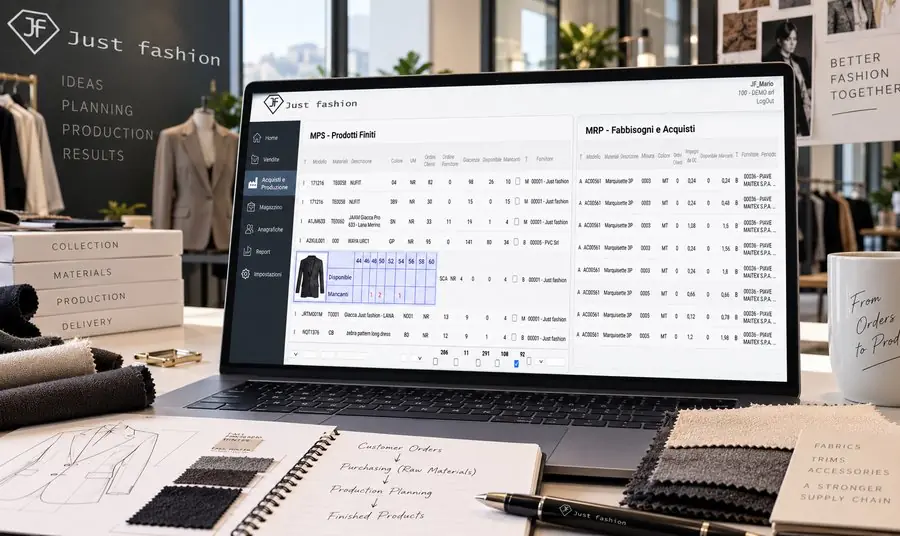 9Purchasing & Production↓
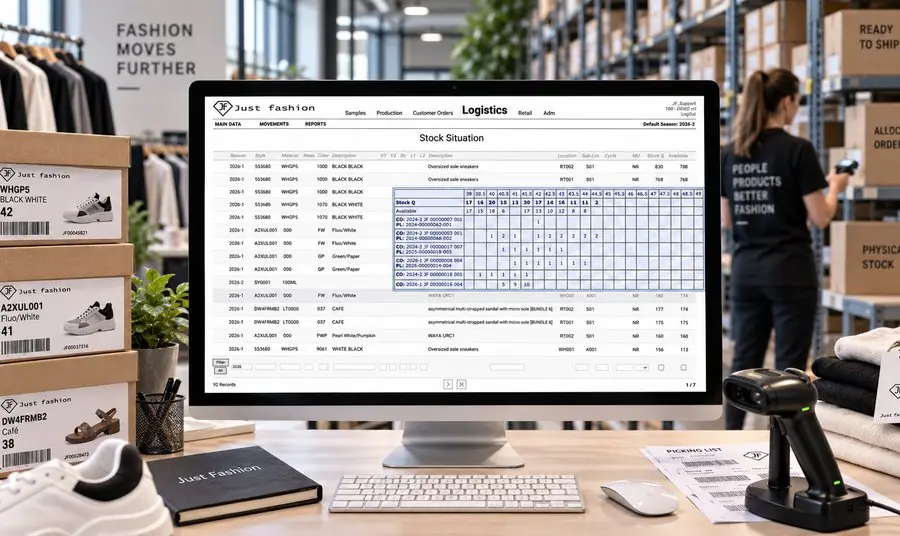 10Logistics & Warehouses↓
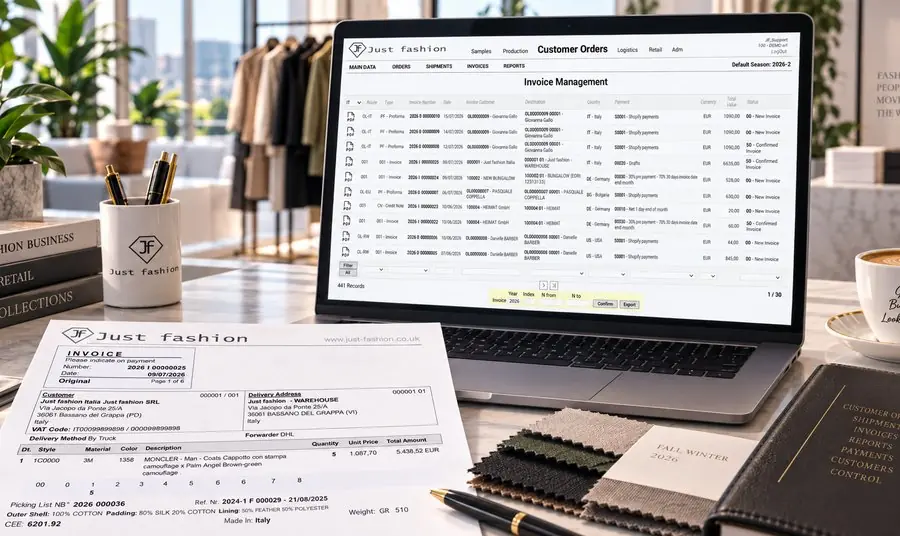 11Shipping & Invoicing↓
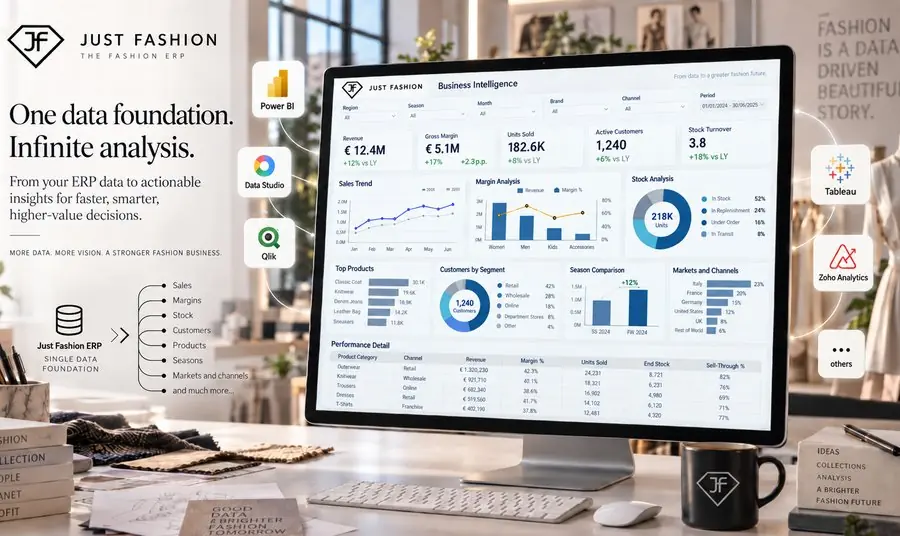 12Business Intelligence↓
 13Fashion AI↓

Developed by specialists with over 25 years of experience in the fashion and luxury industry, Just Fashion is a vertical ERP built around the real processes of fashion companies, not a generic business system later adapted to the industry.
Seasons, collections, styles, materials, colors, sizes and variants are part of the system's native structure. The same information follows the product throughout its entire lifecycle: from collection development to orders, from production to warehouse, through sales, shipping, invoicing and data analysis.
Just Fashion is designed for brands, manufacturers and mono- and multi-brand retailers, with B2B and B2C processes managed within a single platform.
A Cloud ERP, accessible anywhere
The Cloud SaaS architecture lets you use Just Fashion directly from your browser, with no server infrastructure to install or maintain locally. The environment can grow with your company, supporting multi-brand, multi-company, multi-currency and international organizations.
Industries and Categories Covered
- ✓ Luxury Goods and High Fashion
- ✓ Women's, Men's and Children's Apparel
- ✓ Footwear and Leather Goods
- ✓ Fashion Accessories (Bags, Eyewear, Jewelry)
One ERP. The entire fashion supply chain.
From product development to sales, from production to logistics through to data analysis. Every process uses the same information, with no duplication and no manual re-entry.

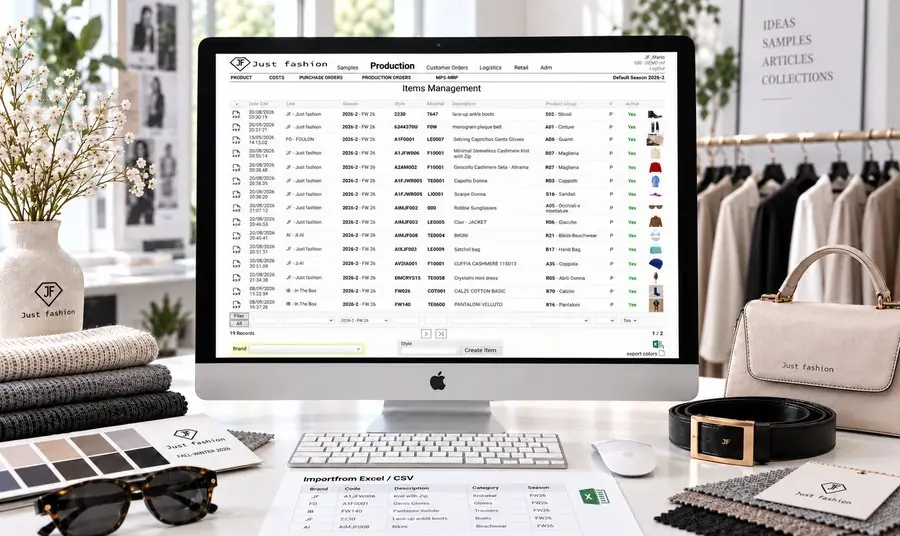
1. Styles, Items and Materials
The development of a new collection starts with the style: code, description, season, line, product category and size grid form the information base that will accompany the product throughout its entire lifecycle.
Materials, fabrics, leathers, trims, colors and variants are linked to the style to generate the collection's items and all their combinations.
Excel import for multi-brand companies.
For multi-brand companies, items can also be imported from Excel files using a dedicated template, speeding up the acquisition of catalogs from different brands and suppliers.

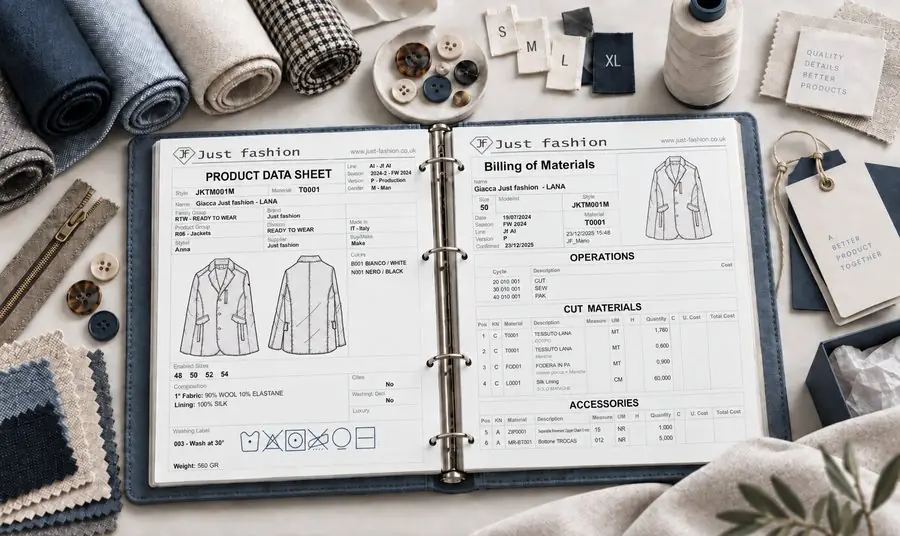
2. Bill of Materials and Components
Fabrics, linings, buttons, zippers, trims, packaging and other components are organized in the product's bill of materials (BOM), with consumption, colors, measurements, suppliers and costs.
The bill of materials makes it possible to determine the item's manufacturing cost and forms the basis for automatically calculating material requirements for production.

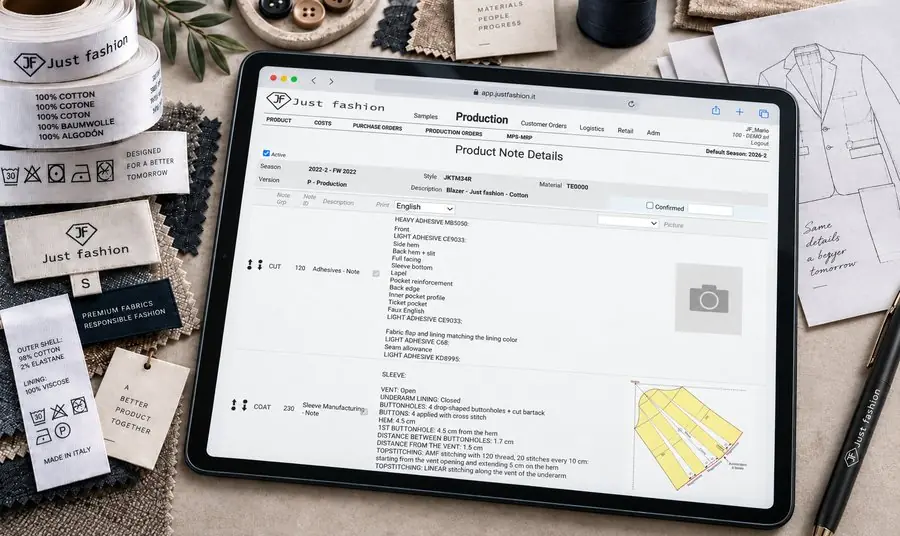
3. Compositions, Labels and Technical Notes
Simple and complex compositions, care instructions, regulatory information, CITES data and specific product characteristics are managed directly in the technical master data.
Text, images and structured notes make it possible to document processes, construction details and instructions for workshops, manufacturers and suppliers.
Just Fashion also integrates with textile label printing systems, transmitting compositions, care symbols and other information in the format, language and layout required by different international markets.

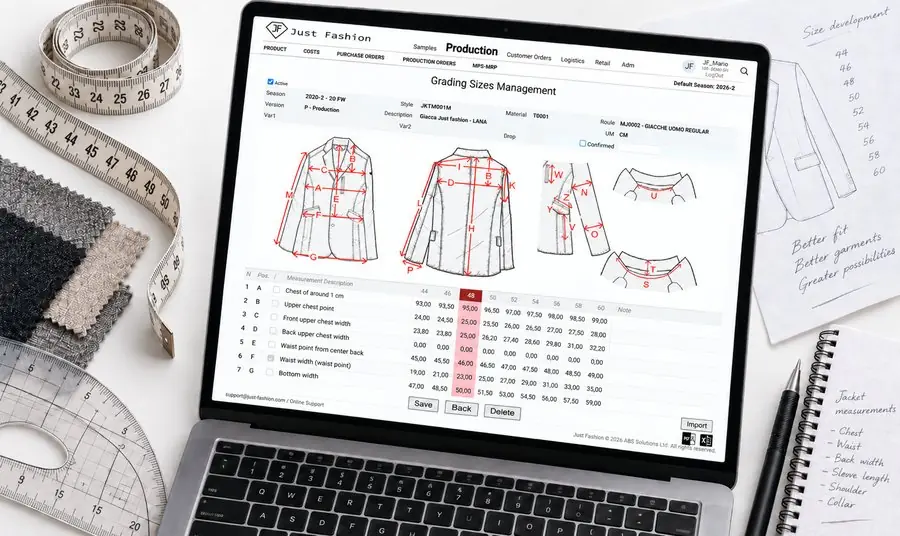
4. Size Development
Measurement charts and grading rules make it possible to define the style's fit and automatically obtain the measurements for different sizes starting from a base size.
The system reduces manual grading work and keeps dimensional information directly linked to the product and its technical data sheet.

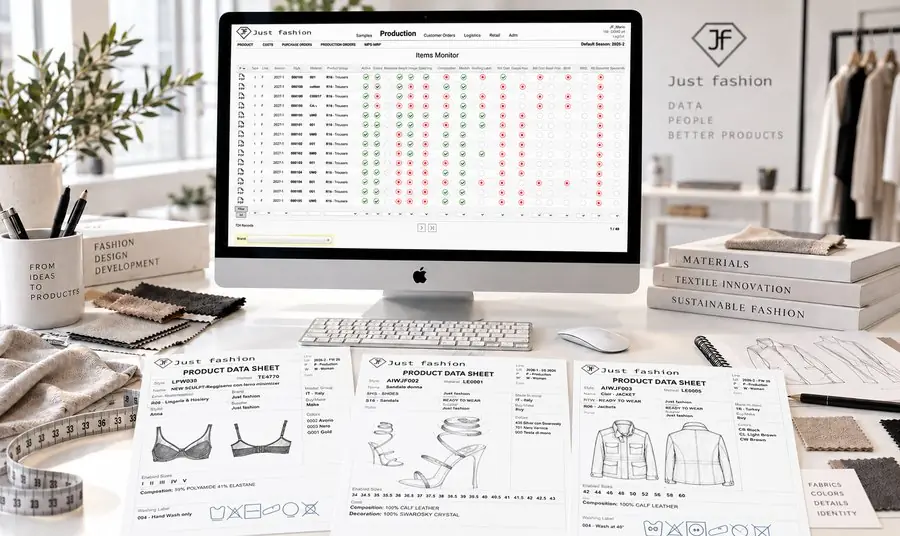
5. Technical Data Sheet and Product Data Management (PDM)
All product information comes together in a single database: styles, variants, materials, color combinations, bill of materials, consumption, compositions, measurements, processes, images and technical notes.
Just Fashion automatically generates multilingual technical data sheets in PDF to share with workshops and suppliers.
The technical data sheet is therefore not a stand-alone document, but the result of information already used by the system for costing, purchasing, production and collection management.

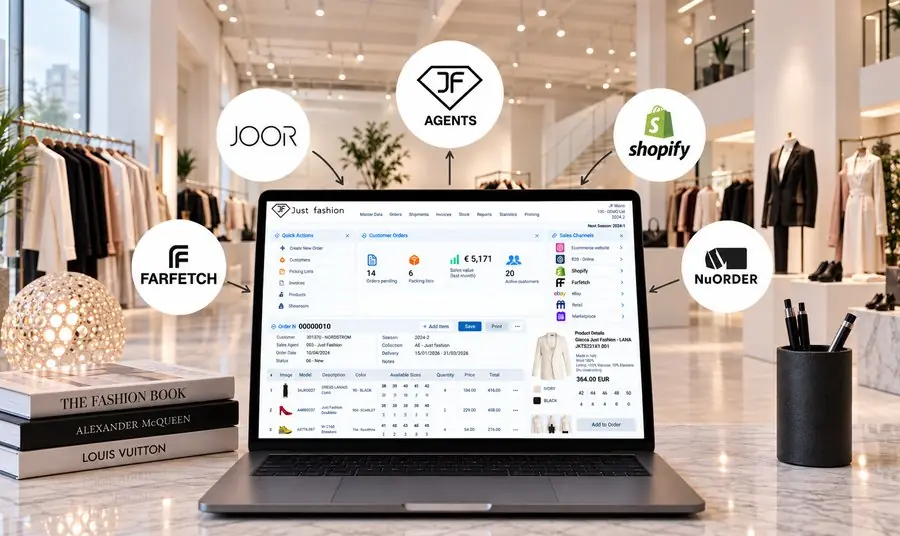
6. Customer Orders, Agents and Showroom
Agents, showrooms and the sales network work directly online in Just Fashion, managing collection orders, pre-orders and reorders through dedicated features and the same company database.
Orders coming from external channels such as JOOR, Shopify, e-commerce and marketplaces flow into the same order book. Just Fashion thus acts as a multichannel OMS (Order Management System).
Price lists, currencies, discounts, trade terms and availability can be differentiated by customer, agent, market or channel. Orders become the basis for allocation, production, preparation and delivery of goods.

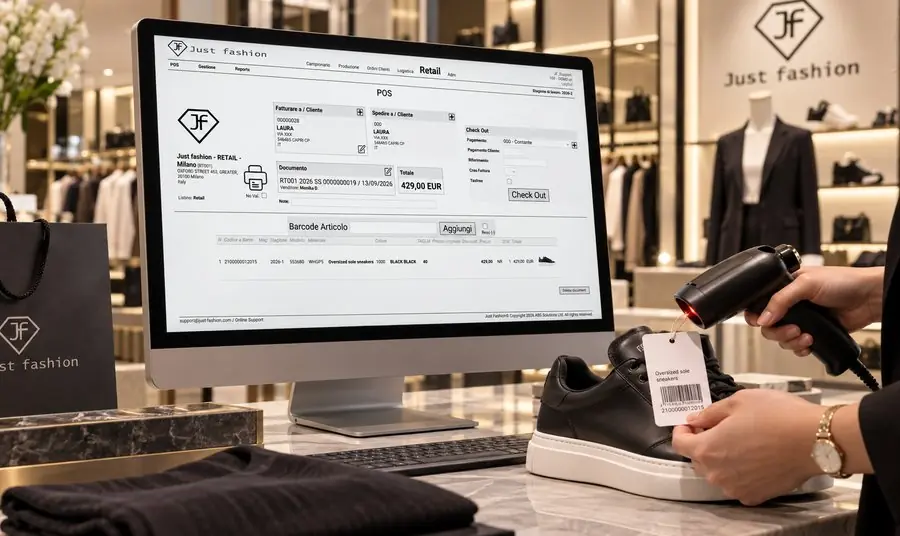
7. Mono- and Multi-brand Retail
Just Fashion integrates the point of sale with the rest of the company: items, prices, availability, customers, sales and returns share the same database as the central management system.
The system supports mono-brand and multi-brand stores and different international tax compliance models, including cloud fiscal solutions in countries where regulations allow operating without a physical cash register.
Store operations update inventory, customer records and sales history, maintaining a unified view between retail and headquarters.

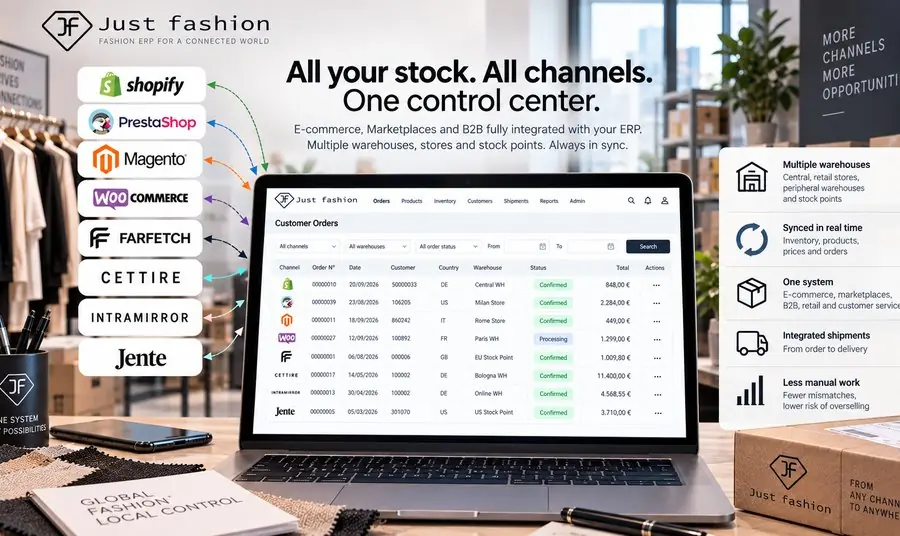
8. E-commerce, B2B and Marketplace
Just Fashion integrates channels such as Shopify, PrestaShop, Magento, WooCommerce, Farfetch, Cettire, Intramirror, Jente and others, synchronizing catalogs, availability, orders and shipments.
Orders flow into the same system used by wholesale, retail and customer service.
All your stock. All channels. One control center.
Warehouses, stores and stock points can feed the different channels, reducing mismatches, manual work and the risk of overselling.

9. Purchasing and Production
Customer orders, forecasts and production plans feed procurement and production processes.
Just Fashion manages multi-level MPS and MRP with real-time requirements calculation, taking into account orders, stock, commitments, availability and supplier orders.
Raw materials, semi-finished goods and finished products stay linked to suppliers, subcontractors, production orders and processing progress across the entire supply chain.

10. Logistics and Warehouses
Raw materials, semi-finished goods and finished products can be managed across multiple warehouses and logical units, distinguishing ownership, location and status of the goods.
Just Fashion keeps physical stock, committed quantities and availability updated in real time, managing incoming goods from suppliers, transfers, movements to subcontractors, production returns and allocations.
The system also manages EAN-13 barcodes and GS1 standards, with print layouts already available for labels on continuous-feed or laser printers.
Availability changes are propagated to connected digital channels and marketplaces, keeping multichannel management aligned and reducing the risk of overselling.

11. Delivery, Invoicing and Electronic Invoicing
From goods availability to delivery to the customer, Just Fashion manages order allocation, picking lists, barcode or RFID, parcel control, packing lists and shipping documents.
The process is orchestrated by shipping rules configurable by channel and flow type (e-commerce, dropshipping, B2B, retail and internal transfers), with courier integration and shipment tracking.
Logistics can also be managed through external 3PL operators, integrated with Just Fashion for orders, movements, availability and shipment progress.
The flow continues through to invoicing and electronic invoicing, with management of down payments/deposits and the ability to generate and print invoices in different languages, keeping order, goods, shipment, tracking and administrative documents linked together.

12. Business Intelligence and Data Analytics
Just Fashion's management data can feed dashboards and Business Intelligence tools to analyze sales, margins, stock, production, customers, products, markets and distribution channels.
Through a dedicated data replica, advanced analyses can be built using platforms such as Power BI, Data Studio, Qlik, Tableau, Zoho Analytics and other BI tools.
A single database makes it possible to compare seasons, companies, markets and channels starting from the ERP's real operational information.

13. Artificial Intelligence
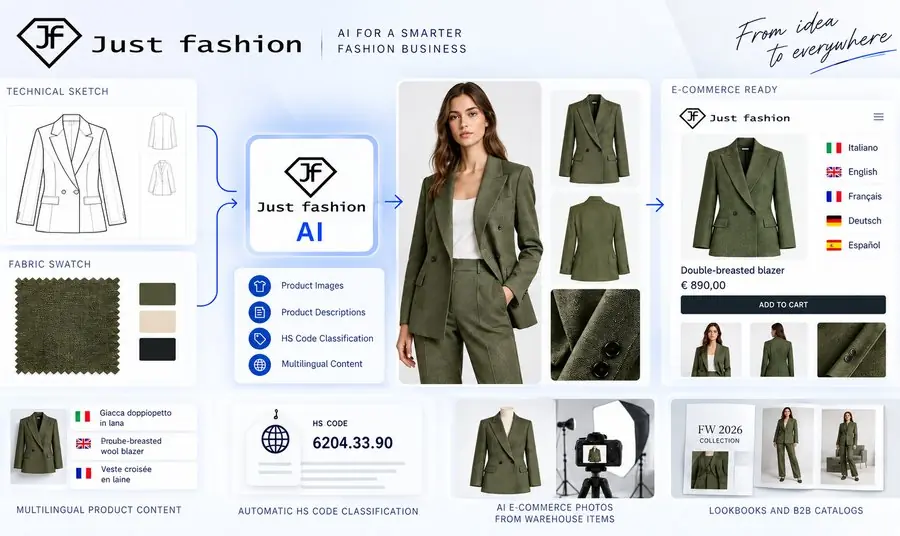
Just Fashion integrates generative artificial intelligence tools to support product development and multichannel communication.
The system can automatically determine HS Codes based on textile composition, processing, gender and product category, and generate photorealistic product images starting from technical sketches and material swatches, including worn by virtual models.
Generation happens with a single click, with no prompts to write and no need to know or learn AI tools: Just Fashion uses the data already present in the system directly to produce the result.
The images can feed lookbooks, B2B catalogs, e-commerce and connected marketplaces. Fashion AI also makes it possible to create e-commerce photos starting from items photographed in the warehouse, and to generate SEO-optimized, multilingual product titles, descriptions and content. Learn more about Fashion AI →
Everything starts from the same data.
A product created in Just Fashion never needs to be re-entered in later stages of the process.
Information follows the product throughout its entire lifecycle and is shared across the company's different departments. A single ERP means less duplication, fewer manual steps, fewer integrations to maintain, and a complete view of the business.